


Every service, accounted for.
Connect the promise, the work and the commercial result. Servexa brings service contracts, scheduling, field execution, quality and job economics into one operating platform.
Follow the job beyond the completion tick.
A service starts with what the customer was promised. It passes through entitlement checks, scheduling, people, parts and field evidence before it becomes a billable record. Servexa is designed to keep that chain together, so operations and commercial teams can work from the same job history.
Build the service around your operating model.
Define services, prices, forms, checklists, approval rules and workflows inside the platform. Its scope spans residential service and commercial facilities operations, including customer and site hierarchies, assets, contracts and subcontractors. Agree the modules and deployment scope around the service lines you intend to run.
Follow the work
Define the promise
Check the customer, service, coverage and price.
Plan the work
Assign the people, time and resources the job requires.
Capture delivery
Record the work, evidence, time and materials at the point of service.
Close the loop
Verify quality and connect the job to cost, billing and follow-up.
An illustrative workflow. The sequence and controls are configured for the agreed scope.
The work Servexa helps you coordinate
The contract and the job tell different stories.
Make the scope, entitlement and commercial rules available where work is booked and delivered.
A busy day does not explain productivity.
Capture travel, work, waiting and material use in the job record to understand where time and cost go.
Closing work should complete the evidence.
Bring checklists, quality checks, consumed materials and commercial status into the closeout process.
What Servexa does
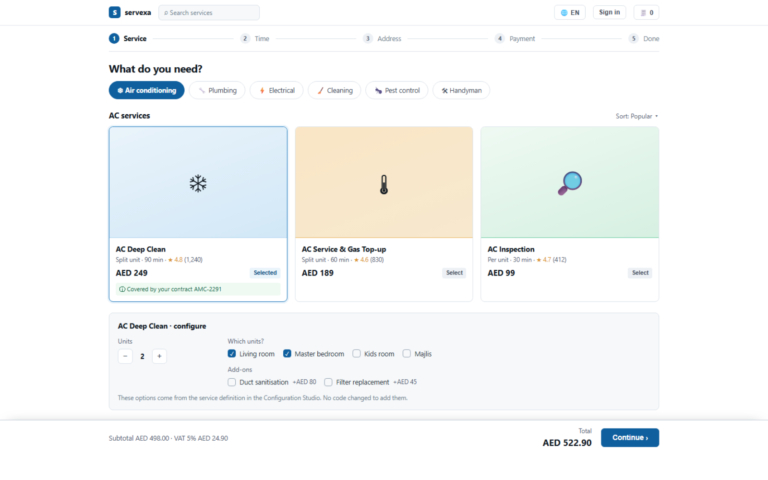
Customers book it themselves
A catalogue with real prices and durations, slot selection, address, payment and confirmation. Where a contract covers the work, the customer is told so before they pay. Built mobile first, because most of them arrive on a phone.
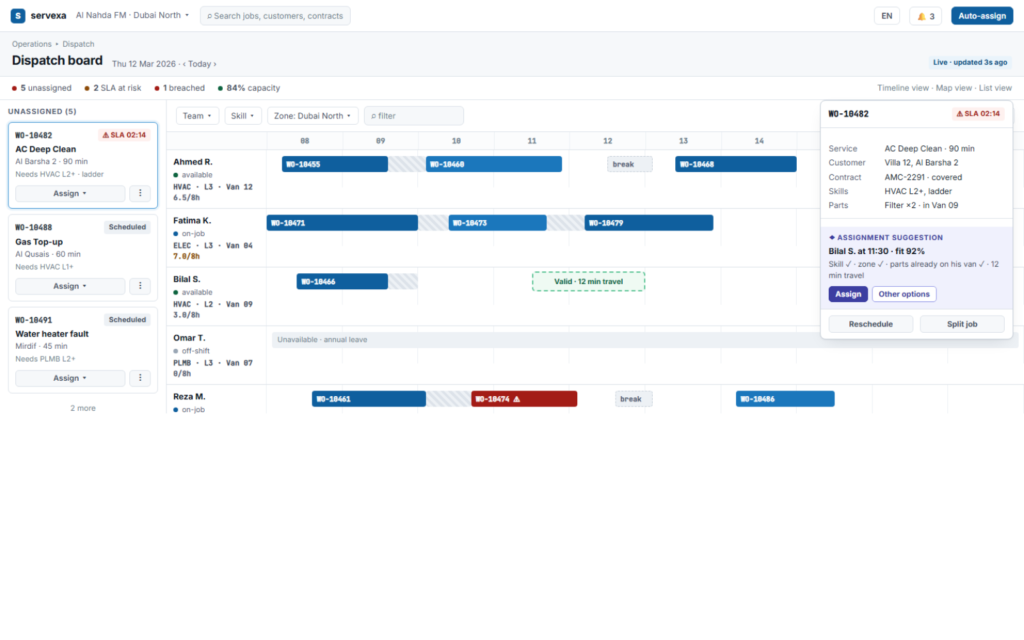
A dispatch board built for a whole shift
Unassigned queue, technician timeline, capacity against the day, SLA countdowns and live status. Drop targets validate skill, zone, parts and overtime before you release, so the rule is learned from the interaction rather than from a rejection.
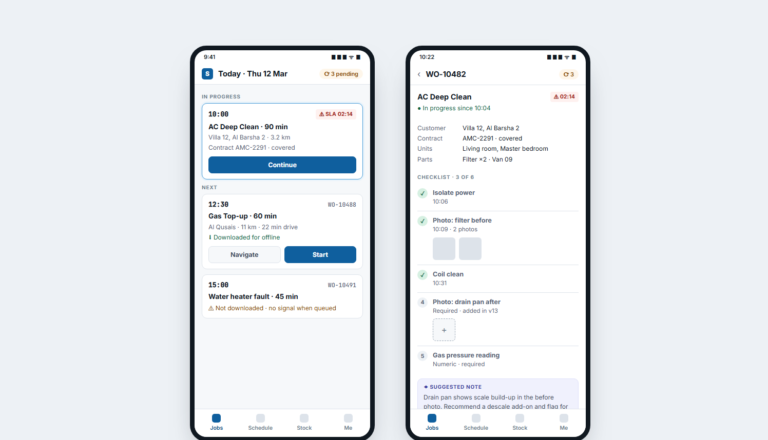
A field app that works without signal
Jobs cached ahead of time, checklists with required photo and numeric evidence, parts drawn from the van, and a sync chip that is always visible so nobody wonders whether the job went through.
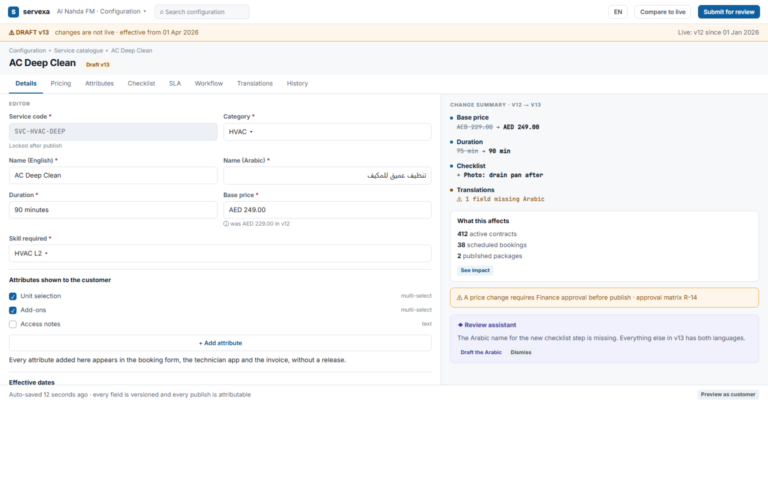
Configuration, versioned
A service is a versioned definition with a draft, a review and a publish date. Change the price and you see the 412 contracts and 38 bookings it touches, and whether Finance has to approve it. Attributes added here appear in the booking form, the field app and the invoice, without a release.
The commercial result, not just the completion
Contracts and entitlements, quotations and subscriptions, materials, subcontractor cost and job economics, so a finished job has a margin attached to it and not only a tick.
Quality that is evidenced
Checklists, photographs, quality scores, complaints and rework linked back to the job record and the person who did it, so a claim about service levels has something behind it.
Workflow as its own engine
Multi-stage side effects, customer notification, route recalculation, parts reservation, run on a dedicated workflow engine with its own database. The interface fires one intent and shows the progress; it orchestrates nothing itself.
Arabic and English as equals
Both languages are first class in the product, not a translation mode: true right to left, Arabic service names beside English ones in the same editor, and a missing translation raised as a blocker before publish.
Inside Servexa
Screens from the product itself, with any account name or customer data replaced by neutral examples. Where a product is still in build, the screen is drawn from its design specification.
How Servexa is put together
Commerce and customers
Service catalogue and packages, booking, payment, customer accounts and properties, quotations, subscriptions and invoicing.
Operations
Work orders, the dispatch board, the assignment engine, capacity and shift planning, routing, SLA management and live queue health.
Field execution
The technician application on iOS and Android, offline job packs, checklists and evidence capture, van stock, timesheets and completion sign-off.
Configuration studio
Versioned service definitions, dynamic attributes, pricing rules, checklists, SLA policies, translations, effective dating and impact analysis before publish.
AI layer, provider independent
Assignment suggestions with the reasoning shown, review assistance that catches a missing translation before it ships, job notes drafted from the evidence a technician captured, and an analytics copilot over approved data. The layer is provider independent by design, so the model behind it is a configuration choice rather than a rebuild, and every answer shows where it came from.
Contracts, quality and intelligence
Maintenance agreements and entitlements, planned maintenance, quality scoring, complaints and rework, and job economics reporting from enquiry to profit and loss.
Plan the fit for your organisation
Where Servexa may fit
Product brochure
What Servexa covers, how it is put together, and what it needs to run.
Common questions about Servexa
Which service businesses does Servexa address?
The solution specification covers residential service operators, field service teams and commercial facilities management. Customer and site hierarchies, assets, contracts and subcontractors support the different operating models.
How much can be configured?
The specified configuration scope includes service definitions, pricing, forms, checklists, documents, roles, approvals and workflows. Implementation starts by mapping your service lines to that scope and agreeing any extensions.
How do we assess modules, AI and deployment?
Use a walkthrough built around one of your service journeys. Confirm required modules, mobile and offline behaviour, provider accounts, hosting, data handling and AI permissions before agreeing a rollout. The supplied specification describes the intended platform scope; the implementation proposal establishes what will be delivered.
Explore our other products
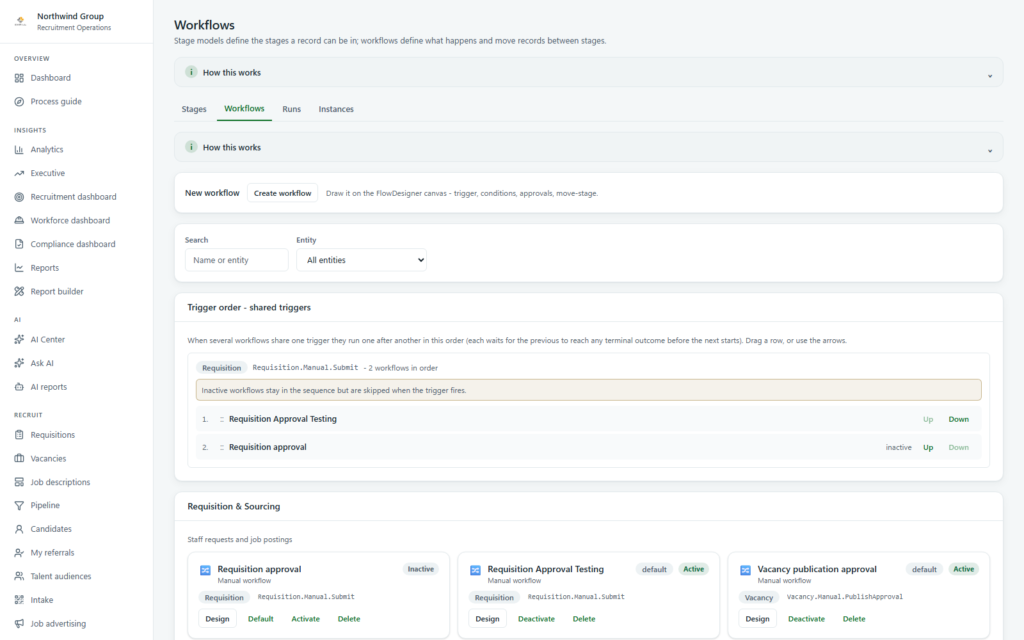
Rovix runs the whole chain from a staff request to somebody starting work: requisitions and approvals, vacancies and pipelines, agencies, offers, onboarding and internal mobility. Four audiences use it, the workflows behind it are drawn rather than coded, and its AI is advisory by architecture.
Explore →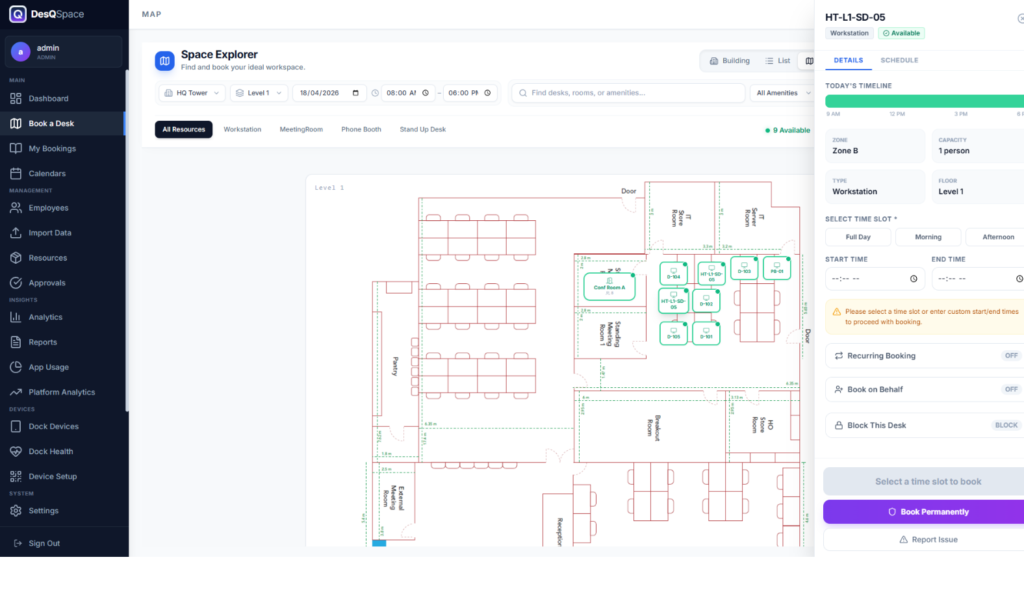
Three connected products, not one. DesQ Space is the control centre on the web, DesQ Go is the employee app on iOS and Android, and DesQ Dock is the screen at the door. Together they turn desks, rooms, lockers and phone booths into bookable resources on a real floor plan, confirm who actually turned up, and show where the space is going.
Explore →What would a better working day look like?
Bring us the process you want to improve. We’ll explore the product, technology and delivery work it needs.